Knowledge and control are forces in the same field.
A manifesto for the third path through personal genomics.
The third path
Personal genomics arrived with two maps of the same human territory. Closed services turned data into finished reports: accessible, legible, and sealed. Public projects turned contributions into shared knowledge: inspectable, reusable, and public by design. Both maps earned their place. Set side by side, they reveal an uncharted interval.
Genodex is building the third path: private exploration, inspectable evidence, and a public network people join by choice. It begins privately, keeps the route from result to source open, and makes every crossing into public knowledge observable. We can explore first, follow a signal to its origin, and decide whether anything travels beyond that boundary.
Genodex is building the community and AI literacy layer for personal genomics. Its first principle is simple: your genome is a strong signal, never a verdict. Evidence gives curiosity direction without collapsing a human life into a prediction.
I. Knowledge and control are forces in the same field
Knowledge and control reinforce each other. Knowledge is the lens; control is the hand on the focus wheel. Together they let us examine genomic information without confusing access with understanding or curiosity with consent.
A compatible raw DNA file can become a private genomic archive and a field of questions. Each supported result stays open to inspection, with coverage and uncertainty in view.
This is genomic literacy in operational form. Evidence distinguishes a strong signal from a fragile one. Calibrated language keeps probability from dressing itself as destiny. The genome becomes useful information while remaining one influence among the many forces that shape a person.
Private exploration and public knowledge occupy the same landscape without becoming the same place. The boundary stays clear, and the decision to cross it belongs to the person whose data gives that crossing consequence.
II. A strong signal, never a verdict
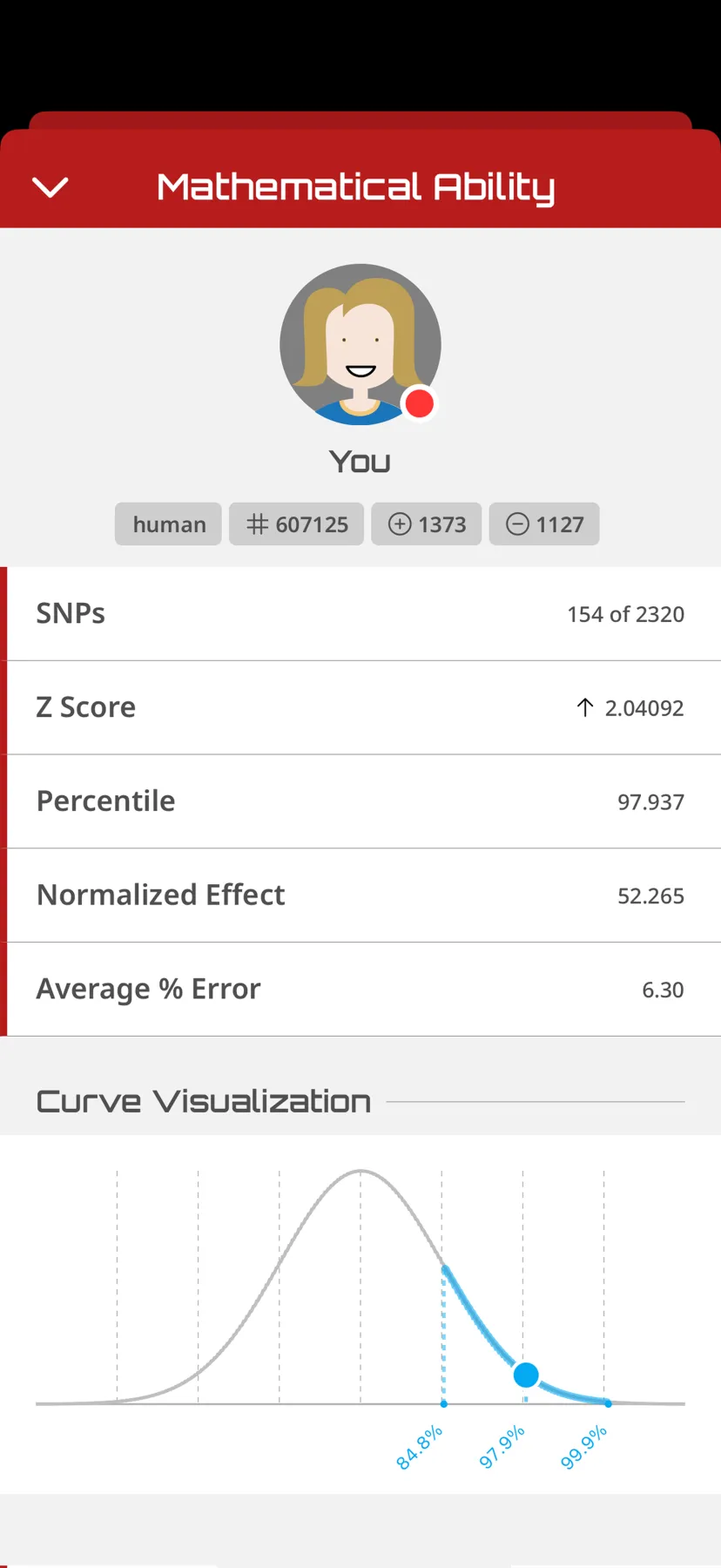
Genome-wide association studies, or GWAS, compare variation across groups of people and reveal statistical relationships between variants and measured traits. They draw population-scale landscapes from probability. Their curves stretch toward infinite edges; individual meaning appears only when ancestry, environment, coverage, model design, and uncertainty enter the frame.
Every association has a position and a shape. Its effect depends on trait definition, study participants, genotyping platform, and population structure. Transfer between ancestry groups may be incomplete. A raw DNA file may omit expected variants. Environmental and social forces may outweigh the genomic contribution. Even strong evidence can explain only a fraction of the variation we observe.
Curves and percentiles locate a calculated result within a model or reference population. SNP coverage reveals how much of the expected variant set entered the calculation.
A percentile may arrive wearing a very serious lab coat; it is still a coordinate. Outcome probability and clinical diagnosis inhabit different landscapes and require different evidence. Genodex serves educational exploration; medical and other high-impact decisions belong to qualified professionals using clinical information and validated methods.
The complete vocabulary of personal genomics includes uncertainty, missingness, bias, effect size, population context, and model version. These properties define the result’s shape. They belong in the picture.
III. Evidence needs coordinates
A polished number can look remarkably self-assured. Provenance asks it where it came from.
Genodex keeps the path between result and source open. Wherever the material supports it, a phenotype model connects to studies and publications, DOI and PubMed records, variants and rsIDs, effect and alternate alleles, genes and related traits, source projects, reference populations, and the transformations used to build the presentation.
That path welcomes different depths of curiosity. We may begin with a plain-language explanation, inspect the distribution and its missing variants, then continue into the underlying paper. We may also stop once the uncertainty is clear. Either way, the claim carries its origin and limits with it.
Provenance also gives correction somewhere precise to land. Studies change, identifiers are repaired, source projects publish updates, and models evolve. A transparent catalog can expose those movements and invite examination. Missing evidence remains visible as missing evidence; an error can be traced rather than merely replaced.
Genomic literacy grows when evidence travels with the result.
IV. Privacy begins as a state
Data does not teleport. It changes state through actions. A compatible raw DNA file can be parsed and used to calculate supported educational GWAS-based results on the person’s device. This local state is the foundation for private exploration, with the deterministic engine working close to the imported data.
Every connected action creates a transition. Account services, synchronization, AI explanations, and public publishing follow different paths for different purposes. Those paths remain distinct. Connected features describe what they send and why; publishing begins through its own explicit act.
The local starting point makes every later movement easier to see. Security still spans the device, backups, operating system, account services, and each connected feature a person chooses to use. Private by default defines the origin. Choice determines the next state.
That transition matters because public genomic data is identifying and can gain further identifying power when combined with other information. Moving from private exploration to public contribution changes the operational reality of the data. The boundary becomes legible before the movement becomes consequential.
Privacy begins with knowing where information is, where it can go, and which action moves it.
V. Publication has an arrow of time
Publication gives information a future of its own. Science advances because people publish observations, methods, and data; communities learn because evidence can be examined and reused. Public knowledge acquires memory. It can travel, combine with other information, and persist beyond its original point of release.
Public contribution therefore follows a separate and deliberate path. The Genodex catalog brings together genomes made public, phenotype evidence, source projects, studies, genes, variants, and public result context. Anyone can browse it without signing in and observe how genomic signals vary across people and populations.
When a person explicitly publishes a genome through Genodex, the contribution is intended to be public under Creative Commons Zero. That choice carries serious and lasting consequences. Genomic data is inherently identifying, contains information related to biological relatives, and may be linked with other datasets now or in the future. CC0 permits broad reuse of rights covered by the dedication; it does not erase privacy risk, guarantee anonymity, or override every law and third-party right. Copies obtained by others may remain available even if Genodex later removes a hosted copy.
This is the arrow of public information: an act at one moment can produce consequences that continue moving through time. Public by choice means seeing what is uploaded, what becomes visible, how others may reuse it, and which movements cannot realistically be reversed.
A community gains strength through informed participation — not through the silent accumulation of data. People who can see the boundary, understand its consequences, and choose to cross it give public knowledge its legitimacy.
VI. The engine calculates. AI makes the evidence legible.
Scientific evidence has structure before it has a story. Artificial intelligence translates dense fields, organizes the facts connected to a result, and helps curiosity form better questions.
The deterministic Genodex engine calculates the scientific result from the available genome data and phenotype model. The calculation remains the source of record. AI begins with a constrained fact set and translates the result, supporting evidence, uncertainty, and limitations into language. The numbers keep their provenance; the explanation gives them grammar.
Fluency earns trust through a path back to evidence. Every explanation leads to calculated values and supporting sources. AI makes that path easier to travel while the engine preserves the reproducible calculation beneath it.
AI literacy and genomic literacy become connected skills. We can inspect the model’s facts and task, then return to the calculation anchoring the answer. The machine contributes language. The evidence keeps the final word.
VII. What remains when interfaces become cheap
Interfaces can appear overnight; gravity takes mass and time. Genodex is building a shared community and literacy layer where individuals explore privately, contributors make deliberate public choices, and explanations stay connected to evidence.
AI will make genomic interfaces cheap to copy. Trust, provenance, community, and a useful content graph remain durable because they accumulate through inspectable evidence, visible corrections, and informed participation. A screen can be reproduced quickly; a network of sources, relationships, memory, and earned trust acquires gravity over time.
We are building toward controlled discussion and contribution tools around that shared material while preserving the distinctions that give it meaning: personal or public, calculated or interpreted, established or uncertain. The community becomes useful because those states remain observable.
The principles are simple to state and demanding to maintain:
calculate supported personal results locally by default;
keep studies, variants, population context, coverage, and uncertainty inspectable;
use a deterministic engine for scientific scores and AI for legible explanations;
make public contribution explicit and describe its consequences clearly;
correct the record when evidence, provenance, or methods change;
keep educational genomic evidence distinct from medical judgment.
Open knowledge has visible sources, visible limits, and meaningful consent around participation. Those constraints give the network structure — and structure gives it strength.
The commitment
We began with two maps of the same human territory. The third path appears when the person whose genome gives the map meaning can inspect its coordinates, understand its uncertainty, and choose which boundaries to cross.
A map becomes a path when knowledge and control belong to the traveler.
That is the Genodex commitment: more curiosity, not fatalism; more context, not certainty theater; more participation, never less control.
A genotype is not a diagnosis. Your genome is a strong signal, never a verdict.